Before highlighting our latest tournament winner, I want to take a moment to appreciate Ethan Krebs for his work and organization in setting up the Cloudy Commons Cup III: Blitzkrieg for a Bolt and its preceding events. While every event has a hard-working organizer at its core, I had the pleasure of attending this tournament, chatting with Ethan over a pre-tournament 1v1 game using draft chaff, and seeing all of his work firsthand. Thank you Ethan for all your support and Justin McNamara for continued prizing support.
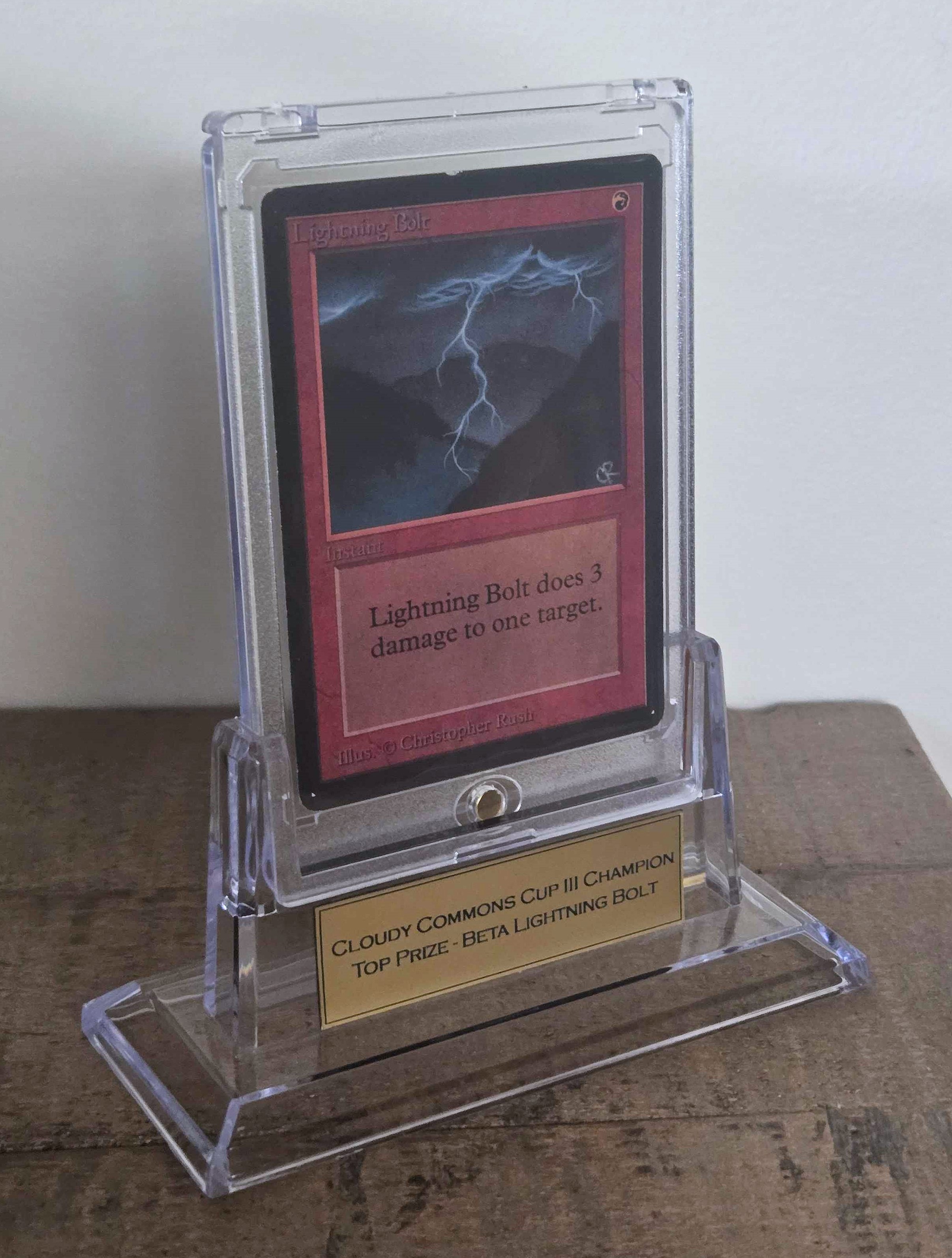
On Saturday, February 28th, I had the pleasure of sitting in the Wyldwolf cafe, drinking one of their dragon-themed beverages while playing an incredibly fun series of games with lovely community members. Clay Lindsey of the PDH RC secured a first-place finish in the event, going completely undefeated with a 4-0-0 record for the day to take home a Beta Edition Lightning Bolt.
Piloting the Simic partner pairing of Ley Weaver and Lore Weaver, Clay’s victories pushed the deck past the 1700 ELO mark, cementing its status at the top of the format.
In a sit-down following the event, Clay detailed the deckbuilding philosophy, in-game restraint, and physical preparation that paved his way to the top. Not having played Weavers myself, I asked Clay for his perspective on his deck along the way.
Why Run Land-Untappers When You Have One in the Command Zone?
As Weavers cements itself as a top-tier threat, distinct deckbuilding ideas are emerging among its best pilots. When comparing Clay’s list to that of another top-five Weavers player, Bobby, there is a surprising 23-card difference.
While Bobby opts for a mana acceleration package featuring one-drop mana dorks (Elvish Mystic, Llanowar Elves, Boreal Druid) alongside Gretchen Titchwillow staples like land-animation tools, Clay views the deck through an entirely different lens. He initially eschewed traditional green dorks, viewing them as fragile targets in a meta increasingly populated by edict effects. (Interestingly, after discussing this topic in our interview, Clay messaged me the next day to let me know he was now testing with the dorks to see what merit they have).
“The way that I see it… I use the untappers as a ritual,” Clay explained. “Where [mana dorks are] one mana in, they get one mana out… For my one or two mana in, I can get two or more mana out.”
This mechanical choice heavily influences the deck’s speed. Built to average a turn-four or turn-five first win attempt, the deck utilizes Vigean Graftmage alongside cheap, instant-speed Burst of Strength-style effects. These spells bypass Graftmage’s historically clunky counter-distribution, untapping the creature and allowing the combo engine to ignite out of nowhere.
A question I had about Weavers is why a deck with an untapper in the command zone would run multiple untappers in the 99. For Clay, it comes down to worst-case scenario planning against board wipes and targeted removal. These extra untappers serve as excellent edict fodder. “I can’t tell you how many times my plans have been thwarted from an edict,” Clay noted. “I say thwarted, postponed is more the appropriate [word].”
If Ley Weaver is repeatedly removed and the commander tax pushes it out of castable range, the deck can easily stall. “If you don’t have any other untappers in the deck, and Ley Weaver gets taxed out of range, you’re screwed,” he stated.
By keeping alternative untappers in the deck, Clay ensures he can still attach auras to a backup creature, generate infinite mana, and sink it into Lore Weaver to draw the deck and win. It provides a vital layer of insulation that cantrips or pure card draw simply cannot offer.
Navigating the Top 4 Finals Game
Having a fast combo is only half the battle; knowing when to deploy it is what separates good pilots from tournament champions. Clay’s third and fourth rounds pitted him against Josh, a highly skilled player piloting a draw-go Gretchen Titchwillow control deck.
Facing down a commander notorious for holding up mana and interacting on the stack, Clay recognized that forcing a combo attempt was a losing proposition. He adjusted his pacing entirely.
In a critical game earlier in the day where he held three Freed from the Real correlates but no protection, Clay simply passed the turn repeatedly, doing nothing but making land drops. In the finals, Clay allowed the table’s Dimir control player and the Gretchen player to exhaust their resources fighting each other. Only when the Dimir player finally eliminated Gretchen did Clay strike, using an Archaeomancer loop to seize the win.
This restraint extended to navigating the board state and his table talk. During the finals, an aggressive Alexios, Deimos of Kosmos deck applied heavy pressure to the pod. Rather than burning his own resources to coordinate removal with the table, Clay stayed quiet and let his opponents panic. His silence allowed his opponents to preemptively strike deals to bounce Alexios, a move that incidentally cleared away an Aether Spellbomb that was threatening Clay’s own combo potential.
In a tournament setting, information is a resource, and Clay is highly selective about how he spends it.
During one game, Clay cast a spell that gave his creature +1/+1, untaps it, and crucially, grants hexproof. When another player asked if the spell won the game on the spot, an opponent incorrectly assessed the board and assured the table it merely generated mana.
Clay did not correct the opponent’s tactical assessment. He simply asked if the spell resolved. When an opponent later tried to cast the removal spell Snuff Out to disrupt the subsequent Freed from the Real combo, Clay pointed out the established hexproof, securing the game.
“I had stated that it gives hexproof,” Clay noted about his initial cast. “I wasn’t going to get on the megaphone and announce it. Everybody was having conversations about what was happening and they seemed content with letting the spell resolve.”
“Make the Plan, Work the Plan”
This laser-focused gameplay is a departure from Clay’s earlier tournament years, where he focused heavily on trying to counter the meta with commanders like Syr Konrad. Today, his philosophy is strictly linear.
“I don’t think about meta matchups anymore,” he said. “I’m trying to do one thing that the deck does, and I’m trying to layer as much redundancy of that one thing on top of each other, and I’m just trying to execute it as quickly as I possibly can.”
He also notes the mental advantage of stepping away from interaction-heavy builds. “I would be hard pressed moving forward to play a control list in a tournament because that’s a lot of thinking. That’s a lot of calories.”
To ensure his execution was reliable, Clay spent the week prior to the Cloudy Commons Cup avoiding late-night league games in favor of intensive goldfishing. Sitting at his desk, he simulated his opening hands and first five turns repeatedly over the course of the week, building the instinct and memory required to pilot the deck smoothly.
What Clay’s Playing Next
During our chat, we also talked a little bit about the meta. While Clay is very talented in piloting his Simic deck, he’s a bit “Weavered out.” We’ve both been high on Longshot, Rebel Bowman. We built the decks around the same time, but our lists differ, again, by about 30 cards. We’re each convinced that our build is more consistent.
We agreed that we’ll both run our decks in the Wanderer’s PDH League this year and see who comes out on top with the higher ranking build by the end of the year. Though we struck up this friendly wager, we didn’t agree on what prize the winner would earn from the other. We’ll have to decide that detail the next time we sit down together after he’s won another tournament.